I sit at my desk 8-10 hours a day, and after labrum surgery on my shoulder I started noticing how much time I was spending with my shoulders rounded forward and my head drifting toward the screen. By the end of most days my neck was stiff and I could feel the tension pulling across the surgical site. Working with direct feedback from my physical therapist at Mass General Hospital Sports Medicine, I built Meridian.
The Setup
MediaPipe Pose is a computer vision framework built by Google. It tracks body landmarks in real time like shoulders, ears, nose directly in the browser with no server or additional hardware at 30 frames per second.
People usually work across more than one screen, so Meridian calibrates for that. During setup you tell it your screen configuration, then sit up straight at each position you actually work from while building a posture profile for each one. When you rotate toward a second monitor, it switches detection contexts. You don't get flagged for looking sideways.
What It Tracks
Three signals:
- Head forward, when your nose drifts past your shoulder midpoint
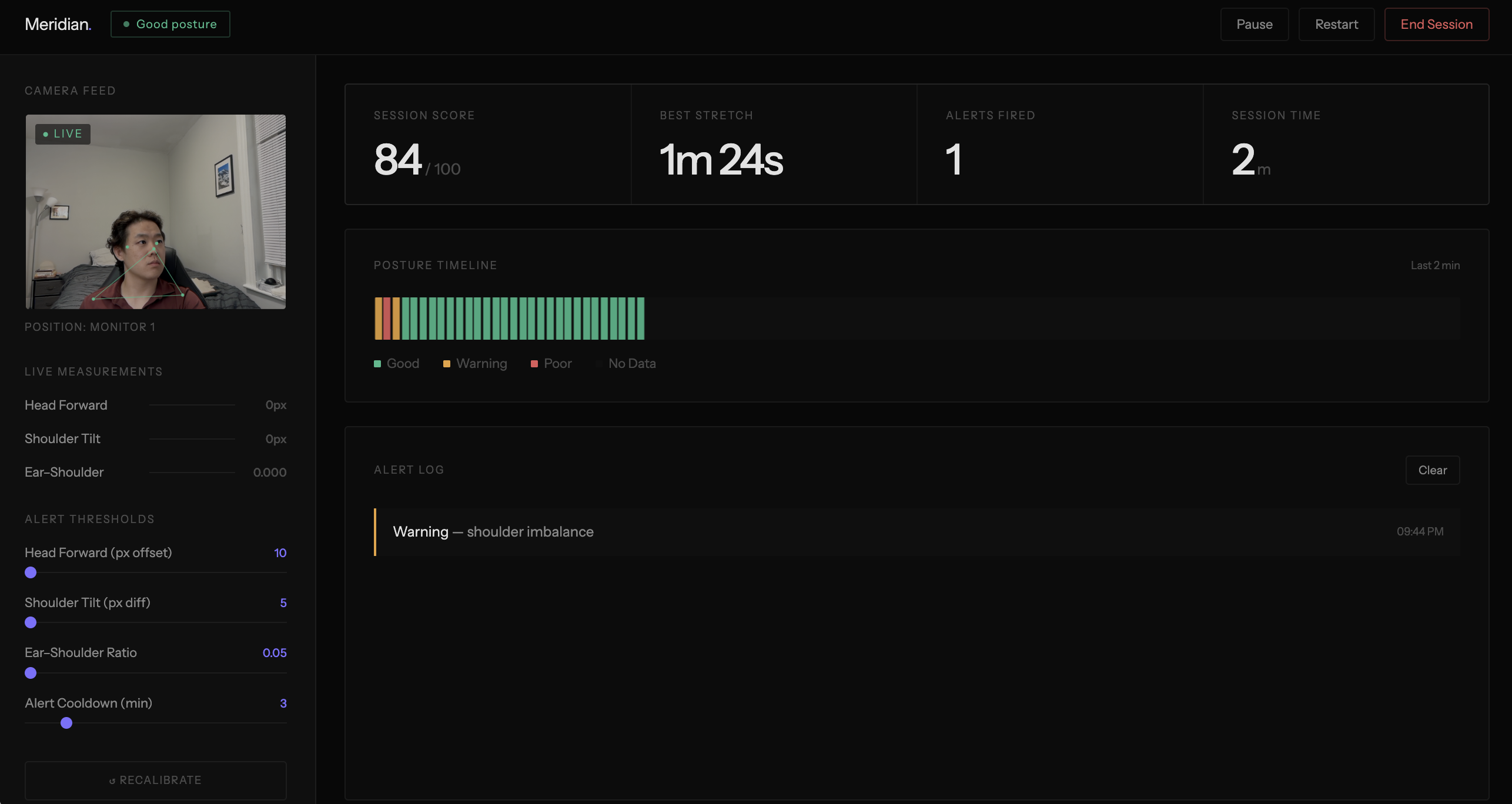
- Shoulder rounding, measured by how much the horizontal distance between your ear and shoulder compresses as your shoulder rolls forward
- Shoulder tilt, left-right asymmetry
Everything is calibrated to your body during a 30-second setup and the system learns what good (and bad) posture looks like for you specifically. Thresholds are relative to your personal baseline, not hardcoded values, which means it works regardless of shoulder width, camera angle, or posture variation.
Privacy
No video is ever transmitted, stored, or processed on a server. MediaPipe runs entirely locally in the browser via WebAssembly. What gets saved to the database is one row of derived numbers per session like score, alert count, timestamps.
The Report
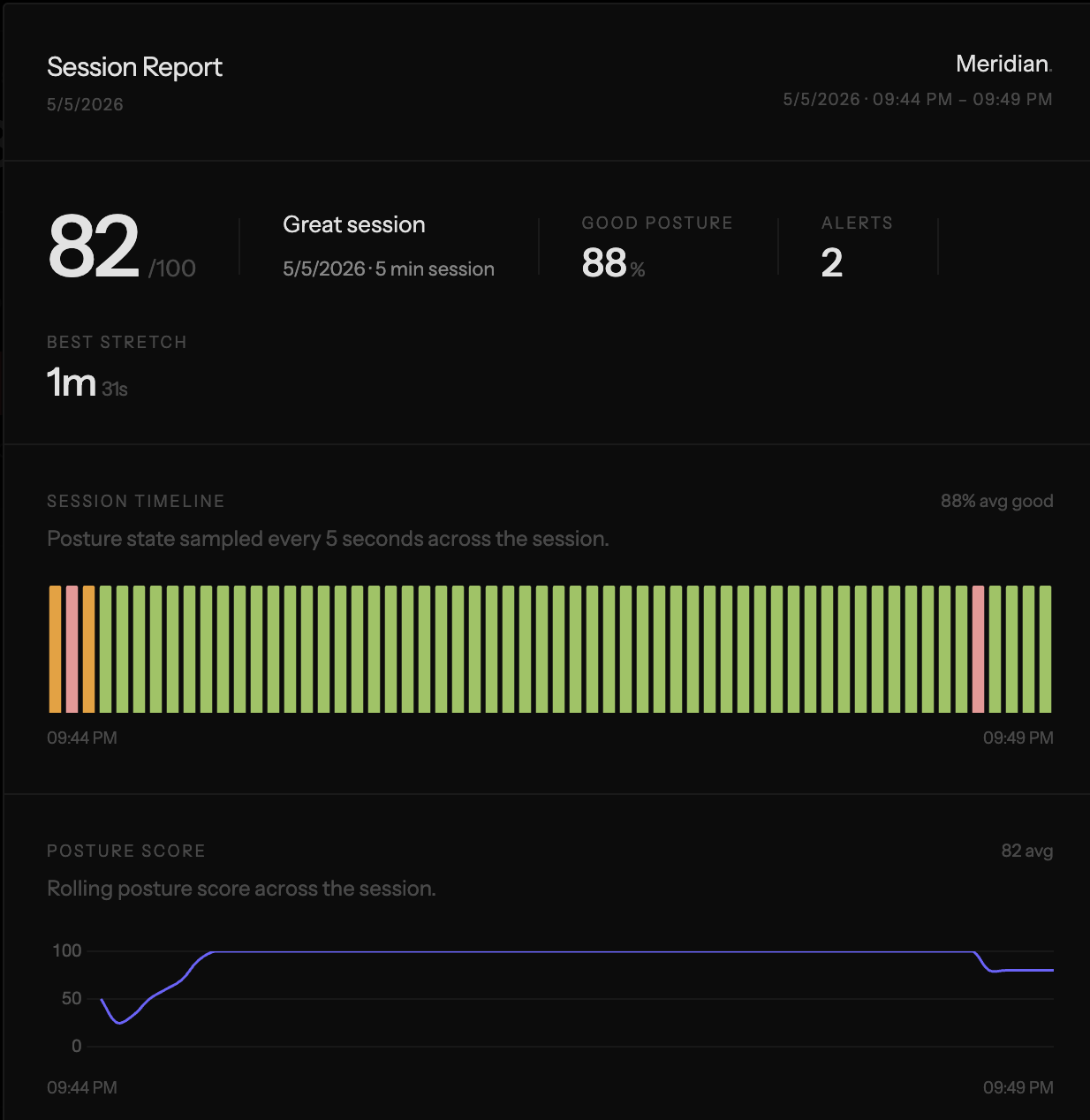
Every session ends with a structured report. A weighted posture score, a color-coded timeline, signal breakdown, alert log with correction times which then exports as a PDF.